Merricat—Uncle Julian
We Have Always Lived in the CastleMary Katherine Blackwood’s bond with Julian Blackwood is shaped by care, mistaken belief, and a remorse that comes fully into view only after his death. When an ambulance takes Julian away during the night, Mary Katherine wishes she had been kinder to him. In the days that follow, she tries to give him a place in the altered household and the landscape around it, preserving his name through a pencil buried by the creek and his memory through a rosebush planted where he had been. Their relationship becomes a measure of what the fire and Julian’s death have taken from the family—and of Mary Katherine’s efforts to keep that loss from becoming complete erasure.
A Bond Complicated by Mistaken Belief
Julian’s understanding of Mary Katherine is revealed as painfully out of step with the reality they share. During the confrontation with Charles Blackwood, Julian insists that his niece has been dead for a long time and says that she died in an orphanage during Constance Blackwood’s murder trial. The claim exposes the depth of his belief in her supposed death, even though Mary Katherine is present in the household. When Charles turns furiously toward Constance, the disclosure also makes Mary Katherine’s identity part of the conflict between the two men.
The later account of Julian’s death gives that misunderstanding a private cost. Mary Katherine remembers that Julian had believed her dead; she now finds him dead in turn. The parallel does not make the losses equal, but it binds them in her recollection: Julian’s belief that he had lost his niece becomes part of the reason his absence weighs on her. Her thought that she should have been kinder is not expanded into an explanation of what she might have done differently. Its force lies in its belatedness, arriving when no further act of kindness toward him is possible.
The Night Julian Is Taken Away
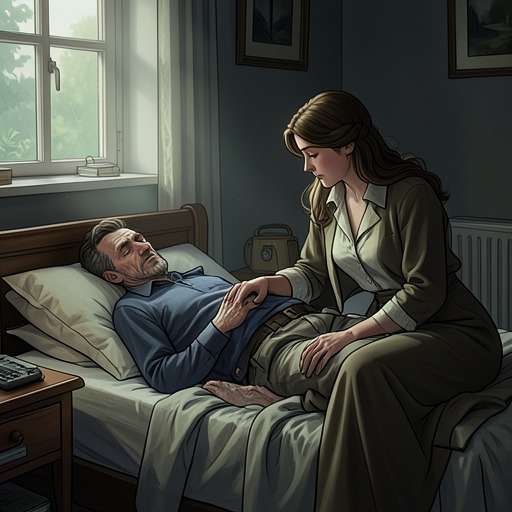
The separation occurs quietly, in the woods beyond the burned house. An ambulance arrives during the night and carries Julian away. Mary Katherine watches its small red light turn into the driveway and hears the subdued voices of the attendants, who speak gently in the presence of the dead. They call toward the women two or three times, perhaps asking whether they may take Julian, but none of them enters the woods. The moment establishes the distance between the household and the outside world even at the point of death: Julian is removed by others, while Mary Katherine remains apart with Constance and Jonas.
Constance has Julian’s shawl wound around her as she sleeps. Mary Katherine wonders whether the ambulance attendants missed it, noticing an ordinary belonging at the edge of this final departure. Sitting by the creek, she wishes she had been kinder to Julian. The scene gives her grief a physical setting and an immediate object of attention, but it offers no conversation or farewell. Julian’s leaving is heard through voices and doors opening and closing; Mary Katherine’s response comes afterward, in memory and regret.
Funeral, Absence, and the House Left Behind
The next day, Mary Katherine asks what will happen to Julian. Constance answers that there will be a funeral and asks whether Mary Katherine remembers the others. Mary Katherine replies that she was in the orphanage. The brief exchange sets Julian’s death beside the family’s earlier losses, while showing that Mary Katherine’s own memory of those deaths is bound to her absence from home. When she says she would like to bury something for Julian, she proposes a personal act of remembrance alongside the formal funeral and burial with the others.
Constance answers that Julian and the others are gone, and that most of the house is gone too; only the sisters remain. Mary Katherine adds Jonas to the list of those left, and Constance says they will lock themselves in more securely than ever. Julian’s death thus coincides with a changed domestic life: the surviving household is smaller, the house is damaged, and the sisters’ isolation is becoming more deliberate. Mary Katherine’s wish to bury something for him emerges within this shared recognition of loss, rather than as a route back to the household they had before.
Objects and Acts of Remembrance
Remembrance takes shape through separate acts by the sisters. Constance plants a yellow rosebush at Julian’s place on the lawn. Mary Katherine buries his initialled gold pencil by the creek so that the creek will continue to speak his name. The rosebush marks a place in the garden; the pencil connects his identity to water and to an ongoing sound. Neither gesture restores Julian, but both give his absence a location and a material trace.
Mary Katherine also persuades Constance to bring Julian’s chair out of his room and wheel it through the garden to strengthen her barricade. The chair looks strange in motion without him. She tries to imagine Julian riding in it with his hands in his lap, but what remains is more limited and concrete: worn spots and a handkerchief tucked beneath the cushion. Repositioned at the barricade, the chair faces intruders with what Mary Katherine experiences as a blank menace. An object associated with Julian’s daily presence becomes part of the sisters’ defense, joining grief to the practical work of keeping outsiders away.
The chair’s new use does not settle Mary Katherine’s fear that Julian might disappear altogether. His papers have been put in a box, the chair has left his room, and his toothbrush has been thrown away; she also worries that even the smell of him may vanish from the room. Jonas begins going into Julian’s room, although he had never gone there before, while Mary Katherine herself does not enter. Her efforts to preserve Julian are therefore active but bounded: she moves his chair, buries his pencil, and notices what is being removed, yet the room remains a place she does not cross into.
Remorse and Continuing Attachment
Mary Katherine’s relation to Julian persists less through a final exchange than through the sequence of her responses: the wish to have been kinder, the question about the funeral, the desire to bury something, and the acts that keep his name and belongings present. These gestures do not erase the distance between them or resolve the contradiction of Julian having believed her dead while she remained beside him. Instead, they show grief working through small decisions about where an object belongs and what should be saved.
The objects also register the family’s changed circumstances. Julian’s chair serves the barricade; the pencil is placed by the creek; the rosebush takes root at his spot on the lawn. Memory is woven into the sisters’ renewed enclosure rather than separated from it. Mary Katherine’s regret remains unanswered, but her acts resist the disappearance she fears: Julian is gone from the room and from the household, yet his name, chair, and chosen place continue to shape how the survivors inhabit what remains.